Electronic receipts can be used for bookkeeping in Hong Kong. The Inland Revenue Department (IRD) accepts computerised business records and scanned images of paper documents in place of the originals, provided the records are complete, remain readable and can be matched to the relevant income or expenditure.
The practical problem is often organisation rather than format. Receipts sit in email inboxes, phone albums and WhatsApp conversations until year end, when some can no longer be matched to bank transactions. Here is what to retain, how to organise it and what to do when a receipt is missing.
Which records must a business keep, and for how long?
Section 51C of the Inland Revenue Ordinance requires anyone carrying on a business in Hong Kong to keep sufficient records in English or Chinese so that assessable profits can be readily ascertained. The IRD lists:
- Books recording income and payments;
- Vouchers, bank statements, invoices and receipts;
- Records of business assets and liabilities;
- For businesses trading in goods, purchase and sales records sufficient to verify quantities, values and counterparties, together with year-end stock lists;
- For service businesses, adequate records of the services provided.
Under section 51C, records must be retained for at least seven years after completion of the transactions to which they relate. For an ongoing transaction, such as an instalment arrangement or a two-year service contract, count from completion of the transaction, not the date of the first document.
Limited companies must also comply with sections 373 and 377 of the Companies Ordinance. The seven-year period for accounting records runs from the end of the financial year in which the last relevant entry was made. As the starting points differ, retain the records until the later applicable expiry date. Keep relevant documents longer where tax enquiries or disputes remain unresolved.
Where tax losses are carried forward, the IRD’s guide recommends retaining the relevant records until seven years after the end of the year in which those losses are fully absorbed. This is a retention recommendation, rather than the minimum period under section 51C. It helps support the calculation if an assessor later asks questions. Closing a business does not remove the requirement to retain records for the applicable period.
Failure to comply without reasonable excuse can result in a fine of up to HK$100,000.
Which electronic documents can support the accounts?
| Document type |
How to retain it |
Points to check |
| Supplier PDF invoices or receipts sent by email |
Keep the original PDF and the accompanying email |
A screenshot that omits the sender or issue date provides weaker supporting evidence |
| Online shopping orders |
Download order details and the platform invoice or receipt |
An order screenshot may omit the amount paid or purchaser name |
| FPS and e-wallet payment records |
Export transaction records from online banking or the app |
Payment alone does not show what was bought; retain the invoice or order too |
| Company credit card statements |
Download and retain each monthly statement |
Match each transaction to supporting documents |
| Thermal-paper receipts from shops, restaurants or taxis |
Photograph or scan promptly after receipt |
Printing fades over time, making delayed scanning less reliable |
| Foreign-language documents |
Keep an image of the original and add Chinese or English accounting notes |
Section 51C requires records to be kept in Chinese or English |
Can paper originals be discarded after scanning?
For tax record purposes, they can, provided the retention requirements are met. The IRD’s pamphlet on keeping business records in electronic form states that taxpayers may retain images instead of original documents without prior approval. It sets out requirements including:
- Reliable scanning and storage, preserving complete and unaltered information;
- Records that can be clearly displayed and read later;
- Files in standard formats specified under the Electronic Transactions Ordinance, so the IRD can access them;
- A responsible person within the business carrying out or supervising scanning, conversion, storage and destruction of originals.
The pamphlet uses read-only optical discs as an example of a medium whose contents cannot subsequently be altered. Cloud storage must likewise preserve integrity, readability and availability for inspection, supported by appropriate access controls and backups. Uploading a document to the cloud does not, by itself, satisfy every requirement. The IRD’s record-keeping guide also warns of the consequences of losing computerised records without a backup.
Documents originally created electronically, such as a supplier’s PDF invoice, need not be printed and scanned again. Retain the original file. The pamphlet also requires information identifying the origin, destination, and date and time of sending or receipt, so retain the accompanying email as well.
As a practical precaution, we generally recommend waiting until the year’s audit and tax filing are complete before disposing of originals, and checking for any other legal, contractual or dispute-related reason to retain them. Keeping original contracts, leases and invoices for significant asset purchases is often prudent.
How should you organise documents for year end?
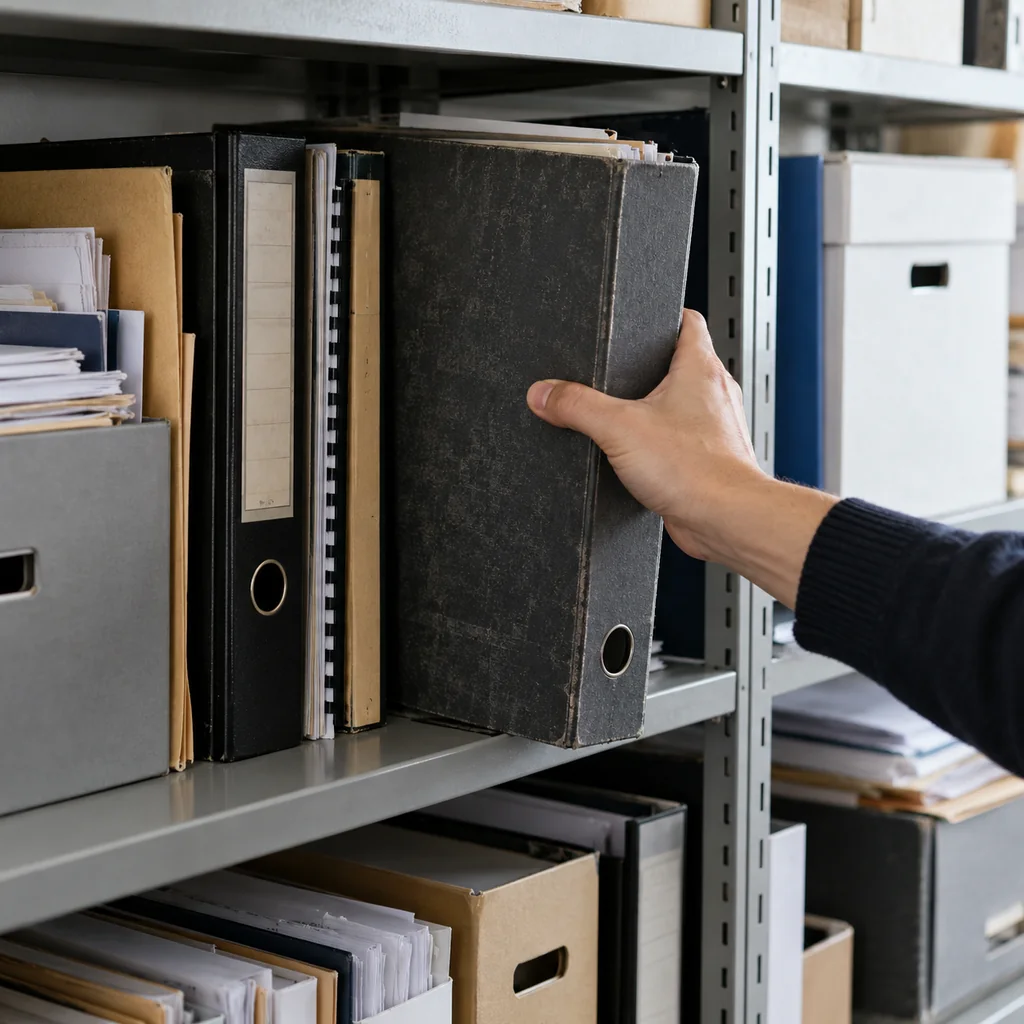
One folder per month, divided into five categories
Use monthly folders for income, purchases, expenses, fixed assets, and bank and payment records. Businesses trading in goods can add a folder for delivery and goods-received notes.
Include four details in each filename
Use the date, counterparty, document number and amount: for example, 20261015_ABCPrinting_INV2381_3200.pdf. When the auditor selects a bank payment for testing, a quick search should locate its supporting document.
Reconcile the bank account monthly
The IRD recommends reconciling the bank statement with the cash book at least monthly. Match supporting documents at the same time and chase missing receipts promptly. This is easier than collecting hundreds at year end.
Separate company and personal expenditure
Directors often pay company expenses on personal credit cards. Retain the receipt and a reimbursement claim recording the business purpose and approval, then record the company’s repayment clearly. Mixed personal and business spending makes verification harder.
If several months of documents have accumulated, our accounting and tax filing services can help organise the records monthly before year end.
Lost a receipt? Five steps to take
- Request a duplicate: suppliers, shopping platforms and telecom providers can often reissue an electronic invoice or receipt. Try this first.
- Find proof of payment: bank statements, credit card statements and Faster Payment System records can establish that a payment was made.
- Gather evidence of the transaction: quotations, order confirmations, contracts, delivery notes, emails and WhatsApp conversations can help explain what was purchased and its business purpose.
- Prepare an internal expense record: record the date, counterparty, amount, purpose and reason the receipt is missing. Have the person responsible and a director sign it, and retain the supporting evidence.
- Tell the accountant or auditor: they can assess the appropriate accounting and tax treatment.
Tax deductibility is a separate question. An expense must meet the applicable deduction requirements, including being incurred in producing assessable profits, and have adequate supporting evidence. A large expense without corroboration may be recorded in the accounts but may not be suitable for a tax deduction. See our guide to Hong Kong profits tax returns and deductible expenses (Chinese).
Do not fabricate a supplier receipt, alter dates or amounts, or ask an unrelated business to issue a receipt for a transaction it did not undertake. That creates inaccurate records rather than fixing the problem. Obtaining a genuine duplicate from the original supplier or downloading the original file is appropriate.
Year-end document checklist
- All bank statements are available and monthly reconciliations are complete.
- Bank payments are matched to invoices or receipts; missing items have been listed and chased.
- Company credit card and e-wallet expenses have supporting documents.
- Director-paid expenses have reimbursement claims and approval records.
- Thermal-paper receipts have been photographed or scanned.
- Foreign-language documents have explanatory notes in Chinese or English.
- Businesses trading in goods have prepared year-end inventory lists.
- Cloud folders have a separate backup.
Electronic receipt bookkeeping: frequently asked questions
Can I photograph receipts with a phone?
Yes, provided each image is complete and clearly shows the supplier, date, amount and transaction details. Retake blurred or cropped photographs promptly. Storage must also satisfy the integrity, readability and retention requirements explained above.
Do electronic receipts need to be printed?
No. Documents created electronically may be retained electronically. The IRD’s pamphlet explains that they need not be printed and scanned again.
When does the seven-year period start?
Under section 51C, it starts after completion of the relevant transaction. For company accounting records, it starts at the end of the financial year containing the last relevant entry. The IRD recommends longer retention where losses are carried forward.
Must an unlimited business also keep documents?
Yes. Section 51C applies to anyone carrying on a business in Hong Kong, whether or not it is a limited company. Businesses operated as sole proprietorships or partnerships generally do not require a statutory audit under the Companies Ordinance, but still need supporting tax records. See our tax filing services for unlimited businesses.
Does changing the year-end date mean reorganising every document?
The documents themselves need not be reorganised: apply the new accounting period’s cut-off. A change affects audit and tax arrangements, so agree the new period and document requirements with the accountant and auditor in advance.
Need help organising your records?
Share your recent bank statements and document folders with us. We can identify gaps and recommend monthly bookkeeping or year-end support. For audit and tax arrangements, see WeCorp’s limited company tax filing services.
Send a service enquiry | Contact us on WhatsApp
Official sources
Information as at November 2026. This article provides general information, not accounting, tax or legal advice. Refer to official guidance and obtain professional advice for your circumstances.